Reconstitution
Bacteriostatic Water 3mL
$10
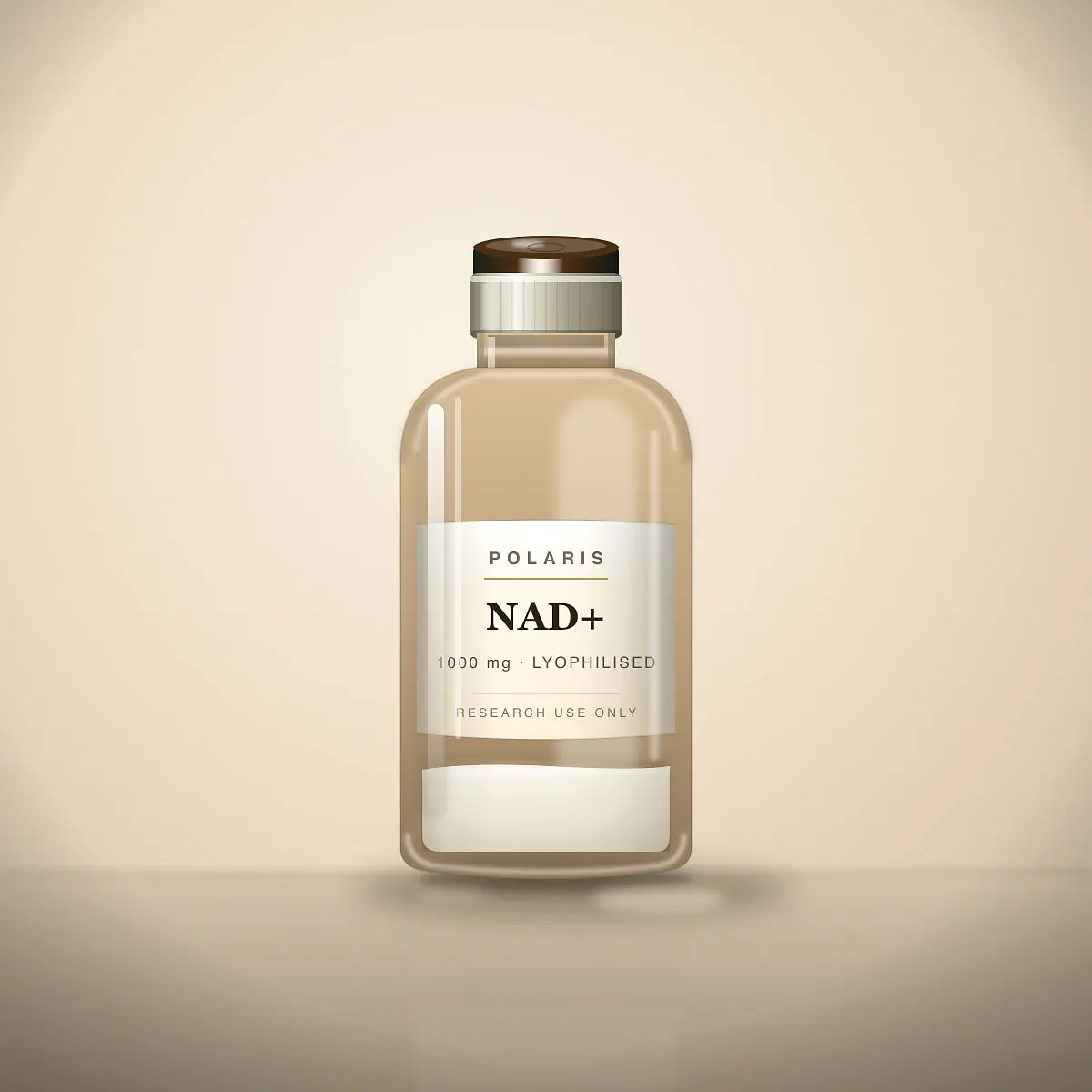
Energy & Longevity · 1000mg
CAS 53-84-9
Or 4 payments of $44.75 with Afterpay. Zip and Klarna are also available at checkout.
NAD+, short for nicotinamide adenine dinucleotide (also written NAD or NAD plus), is a coenzyme central to cellular energy metabolism, studied for redox, mitochondrial, and healthy-ageing pathway research. Unlike the peptides in the catalogue, NAD+ is a dinucleotide cofactor rather than an amino-acid chain, and it is one of the most studied molecules in cellular-energy research. The high-capacity 1000mg vial is the standard format for this category.In preclinical and in-vitro research, NAD+ is investigated for its role in the redox reactions that power cellular metabolism and for the mitochondrial and sirtuin-signalling pathways associated with cellular ageing. Because it sits at the centre of energy metabolism, it is studied across a wide range of cellular models, which is what makes it a reference molecule for the longevity and cellular-energy family.Researchers studying cellular-energy and longevity pathways sometimes look at NAD+ alongside other members of the energy-and-longevity range, such as Glutathione and SS-31; our NAD+ and cellular energy library guide goes deeper into the pathways it is studied for. The 1000mg vial provides ample material for extended cellular-energy investigation.Every 1000mg vial ships lyophilised with an independently verified batch certificate at a guaranteed floor of ≥98% purity, verifiable on the batch verification page using the batch number on the label. Reconstitute with bacteriostatic water: add it slowly down the inside wall of the vial, swirl gently, and never shake. Store the unopened vial at 2 to 8°C; refrigerate the reconstituted solution and avoid repeated freeze-thaw cycles. CAS reference 53-84-9.Buying NAD+ in Australia is domestic and direct: free Australia Post Express shipping Australia-wide with no minimum spend, dispatch from within Australia, and tracking on every parcel. Pay by card, PayPal, or PayID; each vial is sealed under argon with a 24-hour payment reservation on your stock. Supplied strictly as a research material for lawful laboratory and in-vitro use, not for human or veterinary consumption.
NAD+ carries 3,092 indexed publications, 207 registered trials, 2 with Australian sites, 13,685 monthly readers on Wikipedia. Research activity sits at 344 papers in the past twelve months against 282 the year before.
Longevity and cellular-energy searches with a lower barrier for new peptide buyers.
3,092 papers, 344 this year · 207 trials, 2 in Australia · 13,685 readers (-8%) · B tier
Prepared with care, sealed under argon, and stored at 2–8°C until dispatch. Reconstitute with Bacteriostatic Water before use. Full preparation and storage guidance included with your order.
Independent third-party research on reptides.co — not affiliated with Polaris Research. Research reference only, not medical advice.
NAD+ 1000mg arrives sealed and research-ready, with a written preparation and storage card in every order. Prepare and store it as set out below, and use the reconstitution calculator to work out your concentration and draw volume before you begin.
Your NAD+ 1000mg vial arrives securely packaged. Refrigerate it sealed at 2–8°C until you are ready to prepare.
Add Bacteriostatic Water slowly against the vial wall, then swirl gently. Never shake.
Once prepared, aliquot and freeze at −20°C. Avoid repeated freeze–thaw cycles.
“The large vial arrived perfectly intact, well cushioned and well packed. Tracking updated promptly.”
“Fast express shipping with tracking and immaculate sealing. Prep notes were clear.”
“Beautifully packaged and clearly labelled. Support answered my reconstitution question within the hour.”
“Quality and packaging were excellent. Delivery took the full three days but stayed tracked.”
“Second order of the big vial and identical care taken. Discreet and well cushioned.”
Educational and product-logistics information only. Nothing here is medical advice or a therapeutic claim.
Research-grade NAD+ pricing in Australia, why a 1000mg vial makes per-milligram the number to read, and where it sits in the longevity research family.
Read →A coenzyme next to its precursor, one step apart on the same pathway, and which one we carry.
Read →The coenzyme at the centre of cellular energy, what NAD+ is, how it differs from a peptide, and why it sits in the cellular-energy family.
Read →Also Searched As·NAD+ is also searched as NAD+, NAD, Nicotinamide adenine dinucleotide, β-NAD, NAD plus, NAD peptide.
NAD+ appears in 3,117 indexed publications going back to 2017, including 356 in the past twelve months. 208 registered trials appear on ClinicalTrials.gov, 2 with Australian sites.
Publications per year. The final bar is the current year, still in progress.
| 2015 | 0 |
|---|---|
| 2016 | 0 |
| 2017 | 2 |
| 2018 | 6 |
| 2019 | 16 |
| 2020 | 27 |
| 2021 | 50 |
| 2022 | 106 |
| 2023 | 122 |
| 2024 | 192 |
| 2025 | 230 |
| 2026 | 249 |